

single vtg gucci foliate bernardaud limoges france flora plate princess grace 34
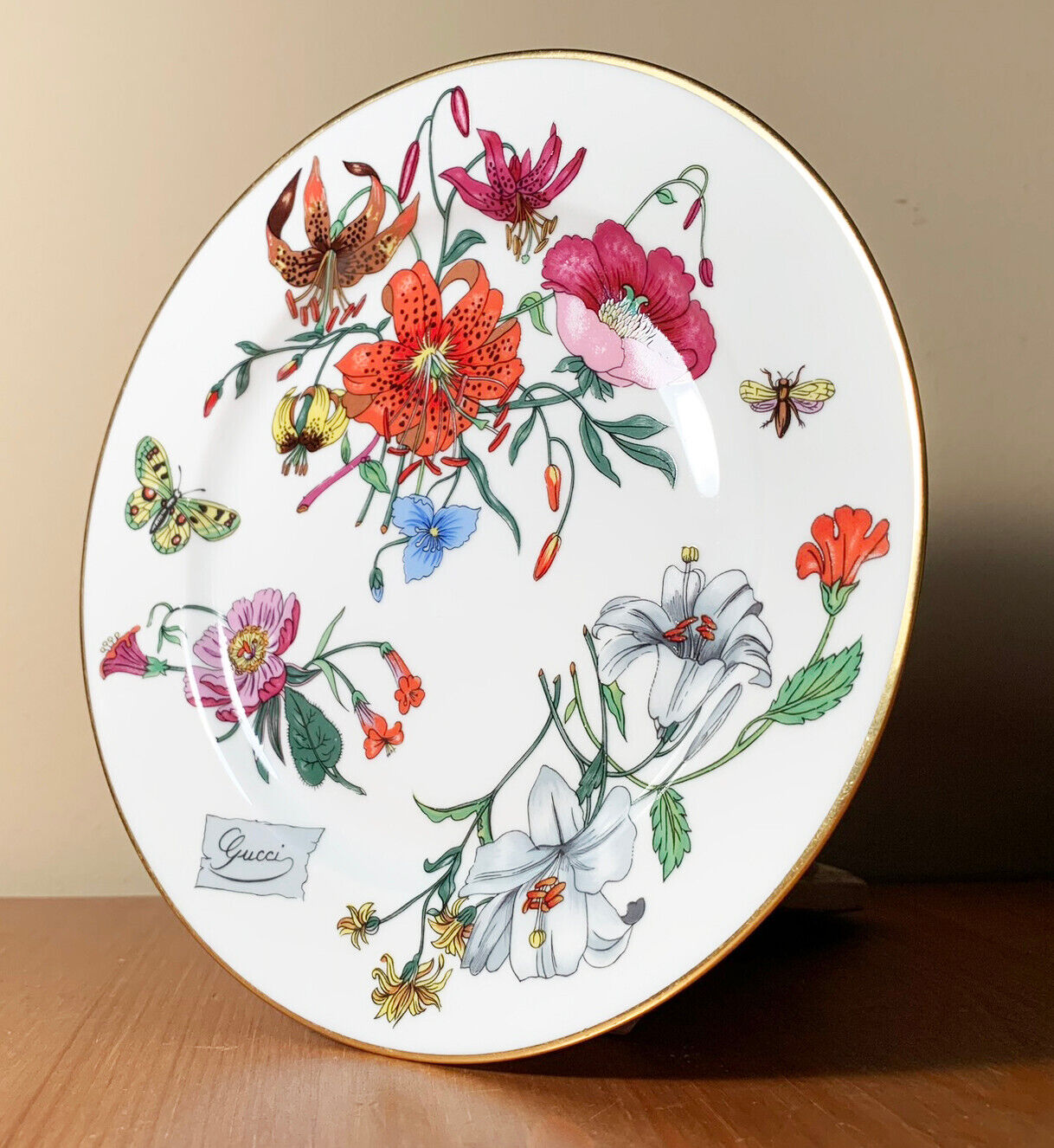
single vtg gucci foliate bernardaud limoges france flora plate princess grace 34
SOLD $250.00 Sold: Mar 29, 2025 on eBayOriginal Listing Description
the plate this is unused. i can find no issues. this is a lovely plate with the very robust, alive, strong, 1970s-1980s gucci floral design called «flora» (you can read more about that below), designed by italian artist vittorio accornero, made famous ultimately by princess grace of monaco. this very famous pattern also line resultied in china made in partnership between gucci and bernardaud (you can read more about them below). the plate is finished in gold. it is a limoges plate and is made in france. from rim to rim, the plate is 7½" in diameter. from the surface on which the plate rests to the rim is ¾". you can view the second-to-last image to gain a sense of scale. it is marked on the surface with «?????» and on the base of the plate with «34» and bernardaud limoges f r a n c e you can view the marks in the detail last image. about vittorio accornero (from: imdb) italian painter, illustrator, stage scenery designer, and, minimally, art director for films. born in casale monferrato in italy's allesandria region on June 18, 1896, he studied at the istituto d'istruzione superiore leardi there. his studies were interrupted by the first world war, in which he commanded alpine troops, trained as a pilot, and was decorated for shooting down enemy planes. after the war, he returned to his art career and flourished. initially working under the pseudonym ninon, later expanding it to victor max ninon, he became a popular illustrator for such magazines as giornalino della domenica and in penombra. in 1923, he won first prize in the el hogar di buenos aires competition, and in 1925, the gold medal of the parisian international exhibition of decorative and modern industrial art. he began that year to design covers for american magazines as well, and in 1929, with his first wife edina altara, he moved to new york. for a while he succeeded in creating set designs for various theatrical productions, but the great depression and his love of italy led him to return home. he separated from his wife in 1934 and devoted most of his work to illustrating over sixty children's books from the works of the brothers grimm, hans christian andersen, Edgar Allan Poe, and a well-received edition of perrault's pinocchio. he obtained work designing sets and costumes for a pair of films in 1936 (under the name vittorio accornero), then moved decisively into the theatre, creating sets and costumes for opera, ballet, and plays at la scala, teatri manzoni, teatri lirico, and teatri olympia in milan. his work from this point forward was under his full real name, vittorio accornero de testa. he balanced his theatrical work with further children's book illustrations and gallery exhibitions of his work. in the 1960s, he expanded his work to fashion, designing ties, scarves, and foulards for gucci, including a famous one made in 1966 for princess grace of monaco. he continued to work in this arena until 1981. he died in milan on march 2, 1982. about princess grace's gucci flora scarf (from: ...did you know that princess grace herself is behind one of gucci's most famous scarves? when princess grace of monaco walked into gucci's milan store in 1966 she had her eye on one of its signature bamboo bags. she had no idea that her shopping trip would lead to the creation of a fashion icon. rodolfo gucci, the son of gucci's founder guccio gucci, was present in the store that day and wanted to offer the princess a scarf as a gift. he knew that, as both actress and royal, grace kelly had famously «reimagined» the luxury scarf, wrapping a silky square around her head as she drove along the grand corniche or tying it into a sporty bandana while attending the olympics. yet nothing in the store that day or even in the entire gucci catalog seemed quite fitting for a princess. and so, rodolfo immediately contacted the italian illustrator vittorio accornero and asked him to design a silk scarf that would capture the elegance, grace, and timeless beauty of her serene highness and celebrate her well-known love of flowers, both fresh and pressed. accornero responded with a painting representing nine bunches of wildflowers, berries, and insects—45 varieties in all—captured in 37 vibrant colors on a white background. the result was flora, the most famous scarf in the history of gucci. it would become the base on which gucci dresses, handbags, and even perfume would be made and it would continue to spawn numerous interpretations as gucci changed creative directors over the course of the next five decades. for more than half a century, the flora print would influence countless gucci collections. whether inspired by «flower power» or «rock and roll eclectic» each new artistic team would shrink or inflate the flowers, and the colors would be reworked as chromatic contrasts against darker backgrounds or explode in fluorescent fireworks. at one point, a snake from the gucci garden was added to give it a new edge. flora transcended generations. princess grace wore the delicate print as a scarf in the late 1960s. in the 70s her daughter, caroline wore flora in the form of a silk blouse for vogue. decades later, the princess's granddaughter, charlotte casiraghi, would become the face of gucci's «forever now» campaign, wearing a simple black top with a flora scarf. the flora motif even inspired an award-winning garden submitted by gucci in the 2014 chelsea flower show in london as well as a roving flora icon exhibition that featured accornero's original hand-drawn sketches and curated Flora scarves, mini-dresses, and handbags from the gucci museum in florence. according to the house of gucci itself, flora has become «a profound expression of the gucci brand, representing new life, femininity, and sensuality». gen z and gucci the magical secret garden of flora continues to flourish even today. earlier this summer, the vogue business index ranked gucci as the favorite luxury brand of gen-z on social media and the fashion house has discovered new ways to introduce the flora legend to this growing market. for its 100th anniversary this year, the italian fashion house chose miley cyrus, the 28-year old multi platinum selling singer songwriter as the spokesperson for its newest fragrance. gucci flora gorgeous gardenia is packaged in a joyful and multi-colored floral bouquet—just the latest «new take» on the house of gucci's iconic flora pattern created decades ago as a thank you gift for a princess. about l bernardaud co. (from: bernardaud) bernardaud's great industrial and artistic adventure began in 1863 in limoges, a region possessing kaolin, fresh water and forests, which are all needed to make porcelain. and the adventure is ongoing! the company has already successfully navigated some of the technical and creative challenges of the 21st century and is facing the third millennium with great resolution léonard bernardaud built up production capacity and opened up new markets, especially in the united states. he was succeeded by his sons jacques and michel, who survived the great depression and world war ii by expanding the company's collections, working with a number of artists. in 1949, they boldly introduced france's first tunnel kiln, which operated 24 hours a day. at first, the tunnel burned city gas, instead of wood. after 1954, it used natural gas from le lacq in southwestern france, a ‹clean› energy that ensured constant heat and improved the firing process. the pieces produced were sturdier and free of defects, which represented a de facto increase in capacity. the company started to produce on an industrial scale, but continued to work according to the high standards of a craft based on artisan techniques. innovate, modernize and create in 1962, pierre bernardaud took over management of the company. he reorganized the business in 1979, opening a new white porcelain plant in oradour sur glane and acquiring several porcelain production facilities, including the ancienne manufacture royale in 1986. he modernized in the 1980s by installing an isostatic press. first, porcelain paste is injected as a powder into a resin mold, then pressure (5,076 pounds per square inch) is applied to compact the powder into the shape of the mold, thus producing the desired object. this technique boosted plate output and quality. under pierre bernardaud, creativity continued to drive the company. he commissioned raymond loewy to design the first contemporary porcelain dinnerware service set. he also launched the first tv ad campaign with a jingle that continues to resonate in the collective consciousness of the french. clearly, the man was a master of forward thinking in the technical and creative fields, as well as communication! about the combination of stamps for r. delinieres & co, l bernardaud & company (from: ...a beautiful specimen indeed! created at r. delinieres & co., limoges, france (mark used 1879-1900) and decorated at the l. bernardaud company circa 1900, the plate is double marked as the product of both companies. the «white-wear», or blank, was produced delinieres, with the «d & c france» in green under glaze, and the «l. bernardaud & company» decorators, marked in red, over glaze. both companies apparently worked in tandem to produce many fine wares around the turn of the century. maker's and/or other marks it is marked on the surface with «?????» and on the base of the plate with «34» and bernardaud limoges f r a n c e you can view the marks in the detail last image. dimensions from rim to rim, the plate is 7½" in diameter. from the surface on which the plate rests to the rim is ¾". you can view the second-to-last image to gain a sense of scale. condition this is unused. i can find no issues. the fine print the images serve as the majority of the listing description, so take a look at them closely. shipping costs have really is calculated into the buy-it-now price. i really add a large amount of packaging to protect what i ship, so that will inherently add alot of weight already. and shipping prices increase greatly with minor increments in weight. i am not able to sell individual items from items i have listed as a group. i just don't have the stamina to create new listings for those. i apologize for that. i haven't initially individually listed items because i don't have enough listing slots to so. trying to downsize some, though extremely melancholically shipping time: i otherwise work more than full time and my health isn't great, so kindly excuse the longer handling time. if i am able to ship sooner, i absolutely will do that. i appreciate you taking the time to view my listing. (Condition: Brand New)
Note: This item has been sold and is no longer available. This page serves as a historical price reference for Limoges collectors and appraisers.
Original Listing Description
the plate this is unused. i can find no issues. this is a lovely plate with the very robust, alive, strong, 1970s-1980s gucci floral design called «flora» (you can read more about that below), designed by italian artist vittorio accornero, made famous ultimately by princess grace of monaco. this very famous pattern also line resultied in china made in partnership between gucci and bernardaud (you can read more about them below). the plate is finished in gold. it is a limoges plate and is made in france. from rim to rim, the plate is 7½" in diameter. from the surface on which the plate rests to the rim is ¾". you can view the second-to-last image to gain a sense of scale. it is marked on the surface with «?????» and on the base of the plate with «34» and bernardaud limoges f r a n c e you can view the marks in the detail last image. about vittorio accornero (from: imdb) italian painter, illustrator, stage scenery designer, and, minimally, art director for films. born in casale monferrato in italy's allesandria region on June 18, 1896, he studied at the istituto d'istruzione superiore leardi there. his studies were interrupted by the first world war, in which he commanded alpine troops, trained as a pilot, and was decorated for shooting down enemy planes. after the war, he returned to his art career and flourished. initially working under the pseudonym ninon, later expanding it to victor max ninon, he became a popular illustrator for such magazines as giornalino della domenica and in penombra. in 1923, he won first prize in the el hogar di buenos aires competition, and in 1925, the gold medal of the parisian international exhibition of decorative and modern industrial art. he began that year to design covers for american magazines as well, and in 1929, with his first wife edina altara, he moved to new york. for a while he succeeded in creating set designs for various theatrical productions, but the great depression and his love of italy led him to return home. he separated from his wife in 1934 and devoted most of his work to illustrating over sixty children's books from the works of the brothers grimm, hans christian andersen, Edgar Allan Poe, and a well-received edition of perrault's pinocchio. he obtained work designing sets and costumes for a pair of films in 1936 (under the name vittorio accornero), then moved decisively into the theatre, creating sets and costumes for opera, ballet, and plays at la scala, teatri manzoni, teatri lirico, and teatri olympia in milan. his work from this point forward was under his full real name, vittorio accornero de testa. he balanced his theatrical work with further children's book illustrations and gallery exhibitions of his work. in the 1960s, he expanded his work to fashion, designing ties, scarves, and foulards for gucci, including a famous one made in 1966 for princess grace of monaco. he continued to work in this arena until 1981. he died in milan on march 2, 1982. about princess grace's gucci flora scarf (from: ...did you know that princess grace herself is behind one of gucci's most famous scarves? when princess grace of monaco walked into gucci's milan store in 1966 she had her eye on one of its signature bamboo bags. she had no idea that her shopping trip would lead to the creation of a fashion icon. rodolfo gucci, the son of gucci's founder guccio gucci, was present in the store that day and wanted to offer the princess a scarf as a gift. he knew that, as both actress and royal, grace kelly had famously «reimagined» the luxury scarf, wrapping a silky square around her head as she drove along the grand corniche or tying it into a sporty bandana while attending the olympics. yet nothing in the store that day or even in the entire gucci catalog seemed quite fitting for a princess. and so, rodolfo immediately contacted the italian illustrator vittorio accornero and asked him to design a silk scarf that would capture the elegance, grace, and timeless beauty of her serene highness and celebrate her well-known love of flowers, both fresh and pressed. accornero responded with a painting representing nine bunches of wildflowers, berries, and insects—45 varieties in all—captured in 37 vibrant colors on a white background. the result was flora, the most famous scarf in the history of gucci. it would become the base on which gucci dresses, handbags, and even perfume would be made and it would continue to spawn numerous interpretations as gucci changed creative directors over the course of the next five decades. for more than half a century, the flora print would influence countless gucci collections. whether inspired by «flower power» or «rock and roll eclectic» each new artistic team would shrink or inflate the flowers, and the colors would be reworked as chromatic contrasts against darker backgrounds or explode in fluorescent fireworks. at one point, a snake from the gucci garden was added to give it a new edge. flora transcended generations. princess grace wore the delicate print as a scarf in the late 1960s. in the 70s her daughter, caroline wore flora in the form of a silk blouse for vogue. decades later, the princess's granddaughter, charlotte casiraghi, would become the face of gucci's «forever now» campaign, wearing a simple black top with a flora scarf. the flora motif even inspired an award-winning garden submitted by gucci in the 2014 chelsea flower show in london as well as a roving flora icon exhibition that featured accornero's original hand-drawn sketches and curated Flora scarves, mini-dresses, and handbags from the gucci museum in florence. according to the house of gucci itself, flora has become «a profound expression of the gucci brand, representing new life, femininity, and sensuality». gen z and gucci the magical secret garden of flora continues to flourish even today. earlier this summer, the vogue business index ranked gucci as the favorite luxury brand of gen-z on social media and the fashion house has discovered new ways to introduce the flora legend to this growing market. for its 100th anniversary this year, the italian fashion house chose miley cyrus, the 28-year old multi platinum selling singer songwriter as the spokesperson for its newest fragrance. gucci flora gorgeous gardenia is packaged in a joyful and multi-colored floral bouquet—just the latest «new take» on the house of gucci's iconic flora pattern created decades ago as a thank you gift for a princess. about l bernardaud co. (from: bernardaud) bernardaud's great industrial and artistic adventure began in 1863 in limoges, a region possessing kaolin, fresh water and forests, which are all needed to make porcelain. and the adventure is ongoing! the company has already successfully navigated some of the technical and creative challenges of the 21st century and is facing the third millennium with great resolution léonard bernardaud built up production capacity and opened up new markets, especially in the united states. he was succeeded by his sons jacques and michel, who survived the great depression and world war ii by expanding the company's collections, working with a number of artists. in 1949, they boldly introduced france's first tunnel kiln, which operated 24 hours a day. at first, the tunnel burned city gas, instead of wood. after 1954, it used natural gas from le lacq in southwestern france, a ‹clean› energy that ensured constant heat and improved the firing process. the pieces produced were sturdier and free of defects, which represented a de facto increase in capacity. the company started to produce on an industrial scale, but continued to work according to the high standards of a craft based on artisan techniques. innovate, modernize and create in 1962, pierre bernardaud took over management of the company. he reorganized the business in 1979, opening a new white porcelain plant in oradour sur glane and acquiring several porcelain production facilities, including the ancienne manufacture royale in 1986. he modernized in the 1980s by installing an isostatic press. first, porcelain paste is injected as a powder into a resin mold, then pressure (5,076 pounds per square inch) is applied to compact the powder into the shape of the mold, thus producing the desired object. this technique boosted plate output and quality. under pierre bernardaud, creativity continued to drive the company. he commissioned raymond loewy to design the first contemporary porcelain dinnerware service set. he also launched the first tv ad campaign with a jingle that continues to resonate in the collective consciousness of the french. clearly, the man was a master of forward thinking in the technical and creative fields, as well as communication! about the combination of stamps for r. delinieres & co, l bernardaud & company (from: ...a beautiful specimen indeed! created at r. delinieres & co., limoges, france (mark used 1879-1900) and decorated at the l. bernardaud company circa 1900, the plate is double marked as the product of both companies. the «white-wear», or blank, was produced delinieres, with the «d & c france» in green under glaze, and the «l. bernardaud & company» decorators, marked in red, over glaze. both companies apparently worked in tandem to produce many fine wares around the turn of the century. maker's and/or other marks it is marked on the surface with «?????» and on the base of the plate with «34» and bernardaud limoges f r a n c e you can view the marks in the detail last image. dimensions from rim to rim, the plate is 7½" in diameter. from the surface on which the plate rests to the rim is ¾". you can view the second-to-last image to gain a sense of scale. condition this is unused. i can find no issues. the fine print the images serve as the majority of the listing description, so take a look at them closely. shipping costs have really is calculated into the buy-it-now price. i really add a large amount of packaging to protect what i ship, so that will inherently add alot of weight already. and shipping prices increase greatly with minor increments in weight. i am not able to sell individual items from items i have listed as a group. i just don't have the stamina to create new listings for those. i apologize for that. i haven't initially individually listed items because i don't have enough listing slots to so. trying to downsize some, though extremely melancholically shipping time: i otherwise work more than full time and my health isn't great, so kindly excuse the longer handling time. if i am able to ship sooner, i absolutely will do that. i appreciate you taking the time to view my listing. (Condition: Brand New)
Note: This item has been sold and is no longer available. This page serves as a historical price reference for Limoges collectors and appraisers.